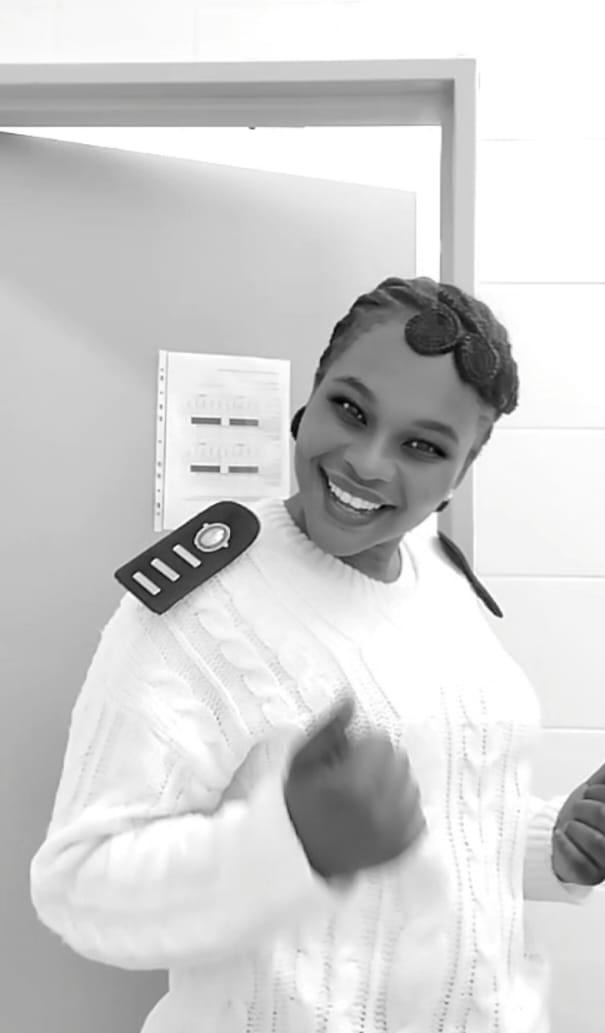
For Thembi Julia Motsepe, the idea behind T1Gluco-Buddy did not begin with technology. It began with what she was seeing in healthcare.
Motsepe is a professional nurse working within Limpopo's public health system and a PhD student at the University of Limpopo, where her research focuses on Type 1 Diabetes Mellitus (T1DM). Her work identified self-care management as an important challenge for people living with the condition, particularly where poor management can affect quality of life and health outcomes.
Her response is T1Gluco-Buddy, a mobile-first digital health platform being developed to give young people living with Type 1 Diabetes more support outside the clinic.
What interests me about the project is that it tackles a part of healthcare that is easy to overlook: most chronic-disease management does not happen while a patient is sitting in front of a healthcare professional.
It happens afterwards.
At home. At school. During meals. When medication is due. When a young person is unsure whether something they are experiencing is normal. And, particularly in rural communities, potentially kilometres away from the nearest clinic.
BUILDING FOR LIFE BETWEEN APPOINTMENTS
T1Gluco-Buddy is currently being piloted in rural Limpopo, with the platform designed around young people aged 12 to 30 living with Type 1 Diabetes.
The project combines diabetes education with everyday support features including medication reminders, health logging and a private channel through which users can communicate with a nurse between visits. Educational material can also be accessed as audio rather than only text.
The original concept was centred on giving patients a stronger understanding of their diagnosis and self-care while helping them engage more confidently with healthcare professionals. Motsepe's project profile also identifies broader patient education, better self-management and improved engagement with multidisciplinary care teams among its goals.
That makes T1Gluco-Buddy less about replacing the clinic and more about extending support beyond it.
And that distinction matters.
Digital health products are most useful when they strengthen the relationship between patients and healthcare systems rather than pretending a smartphone can replace professional care.
DESIGNED AROUND RURAL REALITIES
One of the stronger decisions behind T1Gluco-Buddy is its focus on the conditions in which the platform will actually be used.
The project identifies challenges including long journeys to clinics, missed school, shared phones and difficulties around insulin storage as realities affecting some of the young people it hopes to serve.
The platform has consequently been designed to remain lightweight and accessible on lower-end mobile devices. Its current pilot can be installed directly from a browser, without requiring a large app-store download, and its typical page weight is listed at under 1MB.
I think this is an important part of the project.
Building a digital health solution for a rural user cannot simply mean taking an application designed for a highly connected urban environment and changing the target audience.
Data costs matter.
The device being used matters.
Connectivity matters.
Digital literacy matters.
And the amount of friction between opening a phone and actually getting help matters.
T1Gluco-Buddy appears to be treating those constraints as part of the product design rather than as problems to solve later.
FROM RESEARCH PROJECT TO REAL-WORLD PILOT
The project has now moved beyond being only an academic concept.
A working version of the platform is available and T1Gluco-Buddy is currently positioning itself for pilot deployment with healthcare partners in Limpopo. Clinics, health districts, researchers and funders are being invited to participate in the next stage, including opportunities to introduce the platform at pilot sites, evaluate its use and contribute clinical or educational content.
That next phase will be important.
A health platform can look promising in development, but the real test begins when it reaches patients and healthcare professionals.
Will young people use it consistently?
Do the educational tools improve understanding?
Does communication with healthcare teams become easier?
Can the platform fit into existing clinical workflows without creating additional pressure for already stretched health workers?
And, most importantly, can its impact eventually be demonstrated through evidence?
Those are the questions that will shape what T1Gluco-Buddy becomes.
WHERE THE PROJECT IS GOING
Motsepe's longer-term ambition is clear: she wants patients living with Type 1 Diabetes to be better informed, more confident in their own self-care and better able to engage with the healthcare professionals supporting them.
The immediate focus, however, is the pilot.
T1Gluco-Buddy now needs to move from a functional digital product into an environment where its assumptions can be tested with real users, healthcare workers and institutions.
That is an important transition for any healthtech project.
The innovation is no longer simply whether the software can be built.
It is whether people will use it, whether healthcare professionals find value in it and whether it can ultimately improve the experience of managing a condition that does not stop when a patient leaves the clinic.
For Motsepe, years spent working in nursing and researching Type 1 Diabetes have now produced something tangible.
A healthcare problem has become a research question.
The research question has become a digital product.
And that product is now preparing to meet the people it was designed for.
That is where the real test of T1Gluco-Buddy begins.
T1GLUCO-BUDDY Innovator: Thembi Julia Motsepe Sector: Digital Health / HealthTech Focus: Type 1 Diabetes support and self-care Location: Limpopo, South Africa Current stage: Rural pilot Target users: Young people aged 12–30 living with T1DM Next step: Clinic partnerships, pilot implementation and evaluation
Explore: T1Gluco-Buddy