What stands out about e-Mzansi Group is that it is difficult to describe it as a conventional technology startup.
The Klerksdorp-based company has developed a portfolio spanning technology and software manufacturing, youth development, construction and infrastructure, and media and telecommunications. Rather than operating these as completely unrelated businesses, e-Mzansi presents them as parts of an integrated model: technology provides systems, skills programmes develop people, and infrastructure creates the physical environments in which those systems can operate.
At the centre of that approach is founder Jabulani Nyamane, whose work with e-Mzansi dates back to 2012.
The company’s development has followed an unusually long innovation cycle. Its technology work began with concepts around public-service administration, moved into digital certification and an Electronic Office platform, and eventually developed into what is now called the e-Mzansi Digital Public Administration Operating System.
That progression is important because e-Mzansi is no longer presenting only an idea. It is beginning to assemble a collection of deployable systems around a much larger question: how can technology, skills and physical infrastructure work together to improve access to services?
BRINGING PUBLIC SERVICES CLOSER TO COMMUNITIES
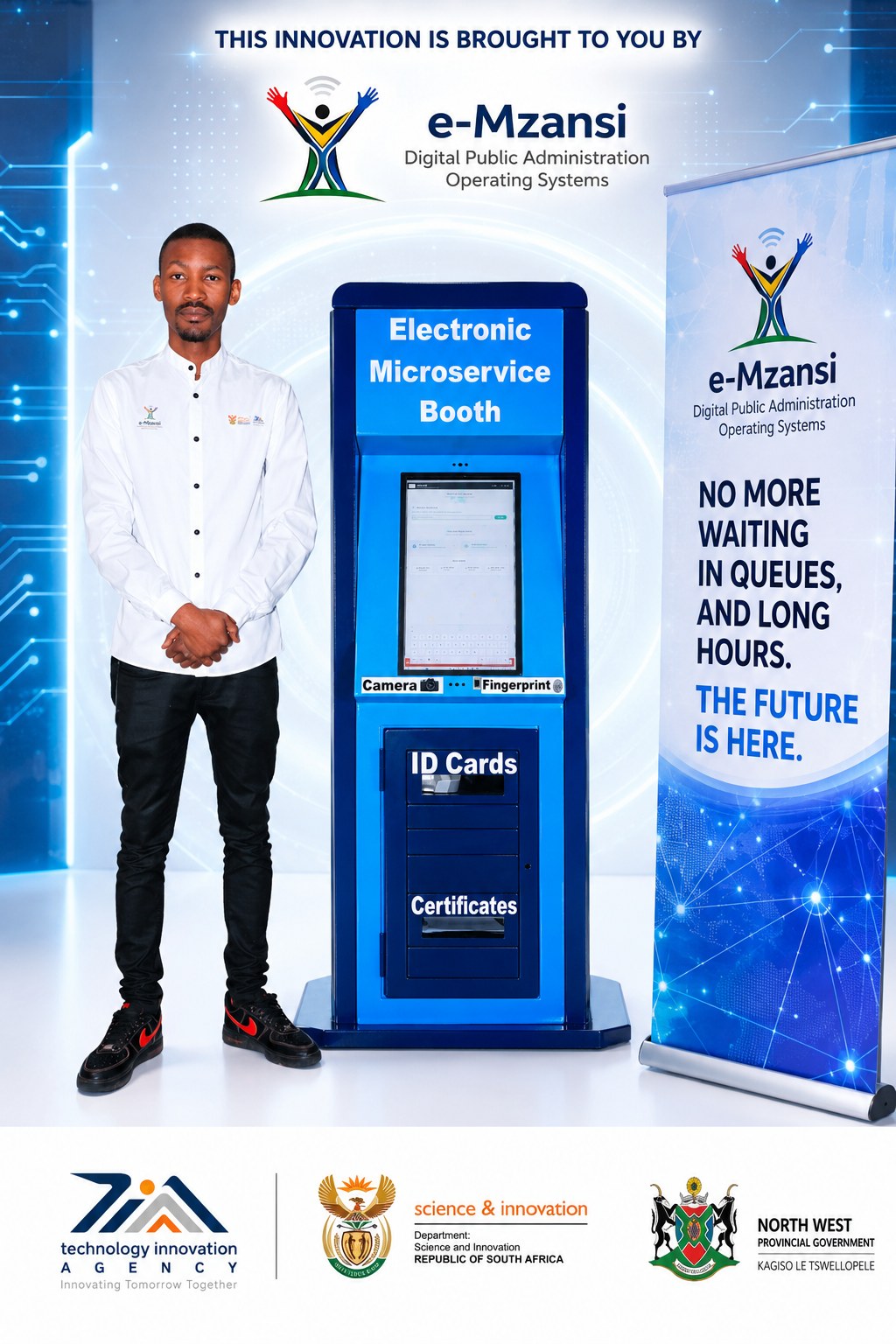
The strongest example of that thinking is e-Mzansi's Electronic Microservice Booth.
The concept is a physical and digital service point designed to support administrative services through one integrated platform. Its publicly described capabilities include biometric and photographic capture, digital document processing and certification, with potential applications across government departments, municipalities, healthcare institutions, banks and universities.
The significance is not really the booth itself.
It is the model behind it.
South Africa has digitised many public and institutional processes, but accessing a digital service can still depend on whether somebody has reliable connectivity, appropriate equipment, the necessary documentation and easy access to the institution providing the service.
e-Mzansi is approaching that problem by asking whether more of that infrastructure can be brought closer to communities instead.
The project reached an important milestone in 2025, when the company recorded completion of a fully functional prototype following earlier support from the Technology Innovation Agency and the Department of Science and Innovation. e-Mzansi also reports investing R250,000 of its own capital into manufacturing, testing and validation.
There is also evidence that Nyamane has started formalising the intellectual property around the technology. South Africa's April 2025 Patent Journal records a provisional application in his name titled “Electronic Public and Private Services Intelligence Systems (Digital Divide Solutions)”.
For an innovation moving from concept toward deployment, that is a meaningful stage of development.
THE GROUP IS BIGGER THAN ITS FLAGSHIP TECHNOLOGY
The Microservice Booth may be e-Mzansi's most recognisable innovation, but the broader company is being built around several divisions.
Its Technology & Software Manufacturing division covers software development, hardware integration, automation, prototyping and local manufacturing.
Alongside that is Youth Integrated Services, a skills-development model that includes the company's Grade 13 concept, entrepreneurship programmes and community-based training. Grade 13 is positioned not as another formal school year, but as a practical pathway aimed at preparing young people for work, entrepreneurship and economically useful skills.
The group also operates a Construction & Infrastructure division covering residential, commercial, industrial and community infrastructure, while I.LIVX extends the group into broadcasting, podcasting, digital media and telecommunications.
On paper, that is an unusually wide range of activities for an emerging company.
But there is a clear idea connecting them.
e-Mzansi is trying to build the technology, develop the people who can participate in the economy around that technology, and create or support the physical infrastructure needed to deploy it.
That systems approach is what makes the group different from a startup built around one app or one piece of hardware.
FROM INVENTION TO AN ECOSYSTEM
The challenge now is execution.
Having several complementary divisions creates opportunities, but it also makes the organisation more complex. The technology business needs to move from prototype into deployment. Skills programmes need repeatable delivery models. Infrastructure projects require their own operational capability. Each division ultimately has to demonstrate that it can work commercially while still contributing to the larger ecosystem.
That next stage will be particularly important for the Digital Public Administration Operating System.
The working prototype establishes that e-Mzansi has moved beyond an early concept. The next questions concern institutional partnerships, pilot deployments, integration with service providers and whether the system can operate reliably at the scale required by public and private institutions. The company currently lists microservice booth prototypes, pilot deployments and development centres among its technology project pipeline.
That is where the business case will be tested.
WHAT MAKES E-MZANSI WORTH WATCHING
There are plenty of startups building software.
Far fewer are attempting to combine software, electronics, manufacturing, skills development and physical infrastructure inside one company.
That makes e-Mzansi an unusual venture.
Its strongest idea may ultimately be bigger than any individual product: the belief that some of Africa's development challenges cannot be solved by technology in isolation.
A service-delivery platform still needs infrastructure.
Infrastructure needs skilled people.
New technology needs manufacturing, installation and maintenance capacity.
And young people need pathways into the economies created around those systems.
e-Mzansi is attempting to connect those pieces.
The company is still at the stage where several of its ambitions need to translate into larger-scale deployments, but it has already progressed from concepts developed more than a decade ago to a functioning technology prototype and a group structure designed around commercialisation and implementation.
For Jabulani Nyamane, that makes the innovation story less about inventing one machine and more about building an organisation capable of turning different ideas into functioning systems.
The next milestone will be proving how far those systems can travel.
e-MZANSI GROUP Founder: Jabulani Nyamane Based: Klerksdorp, North West, South Africa Focus: Technology / Digital Public Services / Skills / Infrastructure / Media Flagship innovation: Digital Public Administration Operating System & Electronic Microservice Booth Current stage: Functional prototype completed; moving toward pilots, partnerships and deployment.
Explore: e-Mzansi Group